by RICK DANLEY // August 16, 2016
Just as we recently lost the last of the living World War I vets, time will remove, perhaps in the turn of another generation, the last of the women who taught in one-room schools.
But for an hour last Thursday, three of the most charming such specimens from this neck of the Midwest stood before an audience of more than 50 and, with sturdy voices, relayed their memories of life in a country school.
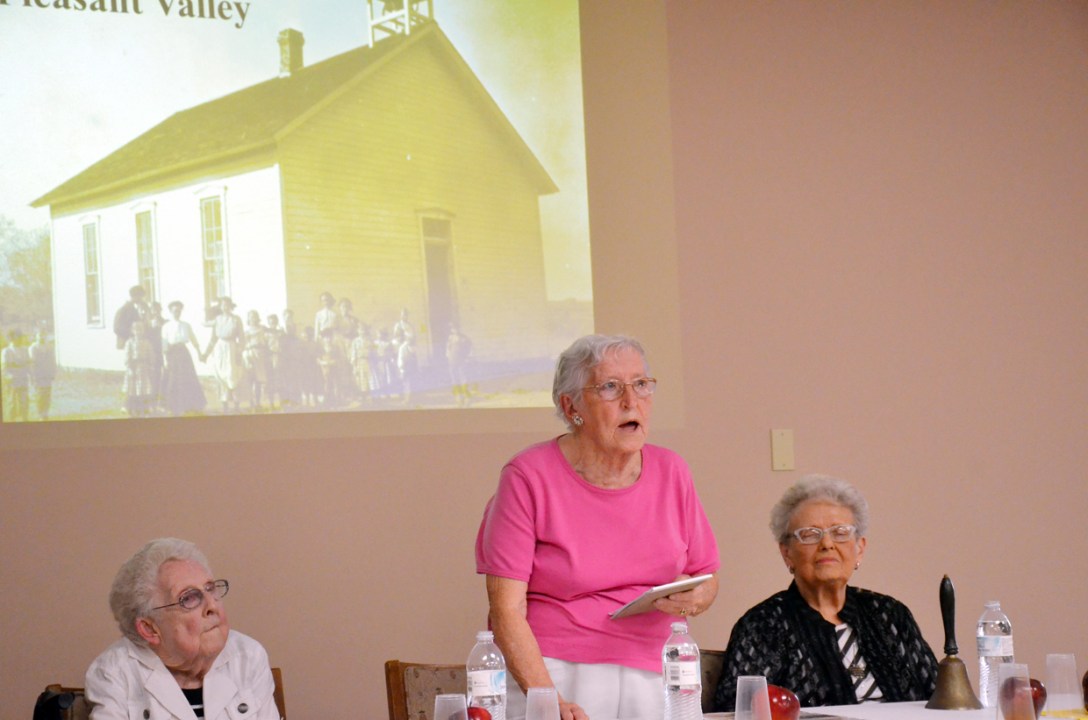
At 17 years old, fresh out of junior college at Fort Scott, Bonita Holeman was in need of a job. One day she received word that the teacher at the Pleasant Ridge School, in Bourbon County, had just left her post. And so, without delay, Holeman straddled her horse and rode the 5 or 6 miles down the road to apply.
“Well,” Holeman said, looking back nearly 75 years, “I got it. And, once there, I was cook, janitor, nurse, and teacher of all grades.”
The great variety of duties that awaited a teacher at a one-room schoolhouse was a key feature of Thursday’s panel discussion at the Iola library.
“You had to sweep the floor, wash the boards, carry in your coal, and then, in winter, build your fire,” Holeman recalled. “And of course we only had one bucket of water and one dipper. For everybody.”
“Once a week I tried to go around and check their hands to make sure they had washed them well and that there was no impetigo going around,” remembered Mary Louise Wilson, who, around the same time, began her teaching career at the Limestone School, also in Bourbon County, about 3 miles north of Bronson.
“But the thing I still think about are the hot lunches,” said Wilson. “That was quite a job, especially for someone right out of high school, fixing lunches for all those children. I’ll tell you, I didn’t think when I started to teach school that I would be holding a book in my left hand and stirring a spoon with my right.”
Wilson had only one rule when it came to food — “They had to at least taste it” — but plenty of rules when it came to her classroom. She would start every year with a list.
“I would tell them that, in later life, they will have rules too, and that it will be necessary to obey them.” A few of Wilson’s classroom basics: No whispering. No chewing gum. No leaving the school grounds without permission. Also, a student must use special hand signals if she wanted to leave her desk.
“Hold up one finger — that let you go sharpen your pencil,” recalled Wilson. “Hold up two and you could go to the restroom outdoors.”
(At one point in the program, a woman in the audience was so moved by the memory of her school outhouses that she had to chime in: “Our school had two outhouses. One for boys and one for girls. And they were fancy — they were two-holers!”)
But rules weren’t a casual luxury in a one-room schoolhouse, where there were often dozens of kids packed into a class, sometimes ranging in age from 6 to 20. They were necessary.
Playing hooky was the most common infraction in those years. Wilson recalled a couple of boys who hid out in the pasture for a day instead of attending lessons. Every now and then she’d see them pop up on a distant haystack, then jump down again and scamper off.
“They were having a playful day. Well, when they came back to school, I told them: ‘You’ve been playing, so now you have to make up the time that you were playing and we were working.’ Oh, they cried — they said, ‘Oh, no, ma’am! Why, we didn’t think you’d do that! We thought you’d spank us and you couldn’t hit hard enough for it to hurt!’”
But teachers weren’t only there to mete out punishment. Occasionally, especially if you were an adventurous farm boy struggling with a rip in your britches, they were your protectors.
“The kids walked through pastures to get to school in those days,” recalled Holeman, “and this boy had climbed over a fence and tore his pants pretty bad. Well, he was afraid to go home, because his dad was pretty harsh. I told him, ‘Listen, I’ll pull out a pin and you crawl back behind the piano and you throw your pants over. Well, I got a needle and thread and I fixed them and threw them back over, and he was happy after that.”
There was organized fun, too — not just the kind mischievous boys created for themselves. “In the spring we always planned something special,” said Wilson. “Like having a picnic out in the pasture or going fishing or, favorite of all, was going to Fort Scott or Iola to visit the fire department.
“And then, of course, sometimes we had pie suppers. They were such fun things.”
“[We] put on three programs a year,” said Holeman, “and, of course, a pie supper.”
Ninety-one-year-old Prudence Fronk was the evening’s first speaker. A small woman, with a kind face and a cap of snow-white hair, Fronk has a hale, clear voice, one that still reaches the back wall of a large room, a voice that makes you instantly sit up a little straighter for fear she’ll catch you slouching. Fronk recalled her years at East Union, a one-room schoolhouse east of Elsmore: “I don’t believe I had all grades, but I had a nice batch of kids. We had music and put on programs. Oh and, of course, we held pie suppers. Those were fun.”
PIE SUPPERS?
A mostly regional phenomenon, pie suppers were social gatherings where homemade pies were auctioned off to raise money for the school. The girls made the pies and decorated the boxes with ribbons and bows. The boys would then bid on the pie boxes. The highest bid won the pie and, crucially, the chance to share the first slice with the pie’s maker. The boxes were supposed to remain anonymous. But, as the three teachers agreed, somehow the boys always managed to figure out which pie belonged to which girl. The pie supper was, at its heart, a courting ritual dressed as a fundraiser.


Toward the end of the evening, an elderly man rose from the audience: “You talked about pie suppers? Well, that’s how I met her,” he said, pointing to the woman at his side. “I was supposed to get her pie, but somebody else had a different idea. They bid, and I bid, they bid, and then I bid. But pretty soon my economics were gone, and so she had to eat with some old bachelor.
“But I got her,” he said.
As he was regaining his seat, the man nodded toward a table displaying a number of historical artifacts rescued from the area’s one-room schoolhouses, a collection curated by the Allen County Historical Society. “That was my old school,” he said, pointing toward a wooden sign that bore the name of his alma mater, “Punkin Kolig (pronounced “college”).
“No wonder I can’t spell!”
The historical society’s Donna Houser — herself a longtime teacher as well as the product of parents who met at a pie supper — described the objects on display and kicked off the night by delivering one of her usual glittering talks, this one on the history of the schoolhouse in Allen County.
THEY WERE all still girls, teenagers, when they started teaching. And while none of them would continue in the profession very long after they were married, their memories of those one-room years are fond.
Prudence Fronk’s boyfriend returned from the Navy after the war, and the pair was married soon after. “And so I didn’t go ahead with my education — which I’m always sorry I didn’t,” said the lively nonagenarian. “I had a daughter and so I started keeping house, and that was the extent of my teaching. But how I enjoyed it. You know, I didn’t have many problems there, not really.” Fronk chuckled. “Or else I was so green I didn’t realize it.”
Mary Louise Wilson was just a girl, too. She lived with her parents while she taught at East Maple Grove and drove their Model A, “a good old car,” back and forth to school.
Seventeen-year-old Bonita Holeman took the money from her first paycheck and bought her mother a new winter coat. “See, she hadn’t had one for 10 years.”
And, as Holeman can tell you, it gets cold when the wind cuts through the hills of Bourbon County. “In winter, you always had to build a fire for the children. I remember one day, I was so cold before I walked to school. You didn’t have slacks back then, remember. You wore dresses. As I was walking, I thought: My hands are so cold I won’t be able to get the key in the door, let alone get a fire built. But when I got up within sight of the school, smoke was trickling out of the chimney. Well, a neighbor down the road had crawled in the window and built my fire. He did that for me and the children. I could have hugged him.”
This article originally appeared in The Iola Register on August 16, 2016.
 RG danley