by RICK DANLEY // March 21, 2016
In the fall of 1911, President Taft was presented with a case of bottled water from the Iola Booster Club.
Attached to each bottle was a label: “This bottle contains Neosho river water, nothing else. … We use this water on our streets, lawns, tables. We drink it, and we vouch for its purity. Please try it.”
It’s not recorded whether the plump Republican sipped from the gift before his train chugged off, but the thrust of the label’s message is as true today as then: The Neosho River, still the area’s main source of drinking water, is, quite literally, a part of the people who live here.
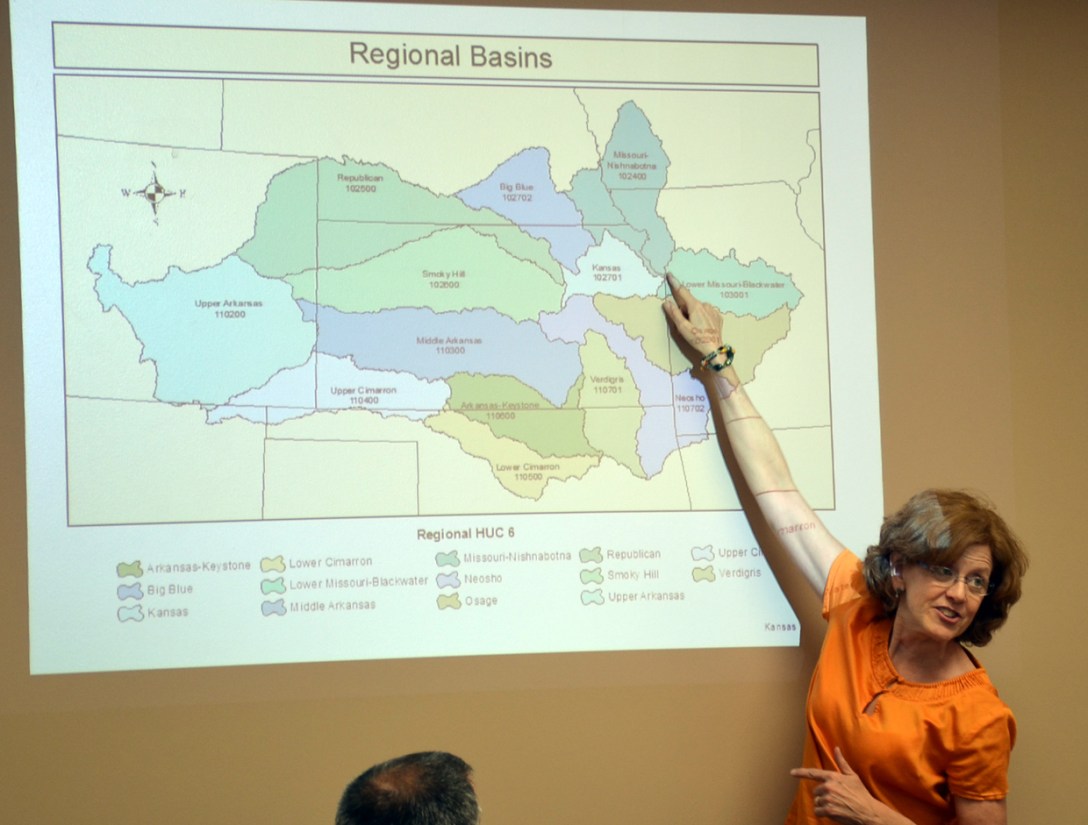
On Thursday, the Iola Public Library hosted a panel discussion devoted to the Neosho River. The event featured Toby Ross, superintendent of the Iola Water Plant; Susan Stover of the Kansas Geological Survey; Allen Community College biology instructor, Travis Robb; and Register reporter and self-described “river rat,” Bob Johnson.
It’s hard to confirm the Booster Club’s claims a hundred years out, but if the 27th president were reinflated today, he’d be unwise to pass up a glass of what, according to Ross, industry experts have recently voted the “best tasting water in Kansas.”
But it wasn’t always the case, averred Bob Johnson. “The early water that was purified often came out of the tap murky and had fish scales in it, and pieces of weed.” Not to mention the many cases of typhoid fever, said Johnson, “which probably came from bad water.”
Turning bad water good
Ross relayed in detail today’s methods for transforming the brown broth of the Neosho — an Osage word meaning, unbelievably, “clear water” — into the award-winning beverage that wets your lips today:
First, water is pumped from the Neosho River into a high-powered “clarifier” at the plant, which acts as “a basic cleanup” mechanism meant to eliminate most of the water’s initial turbidity. From there, it moves through the “ozone system,” which is the plant’s main disinfectant, “and which takes care of taste and odors.” Next, it’s on to “lime softening,” which reduces the water’s natural hardness. From there, the stuff is blasted with CO2, which lowers the pH of the water, before traveling into one of four “dual media filters,” each consisting of a layer of anthracite coal over a layer of sand through which the water filters. At this point, it sluices into an underground “transfer well,” where fluoride, chlorine and ammonia sulfate are added to the mix. Nearing the end of its journey, it moves to the “clear well…which is basically a million gallons of storage and a pump that pumps it to town.” Finally, it is hurled through 70 miles of municipal water mains and into the city’s three water towers,” and, from there, to your cup.

The easy symmetry of this process, of course, depends on the general health of the Neosho River, and the general health of the Neosho River depends in large part on the efficient functioning of the John Redmond Dam.
Just do the dam dredging
Discussion of the upstream dam’s impending dredging project — which aims to remove 3 million cubic yards of sediment from the bed of the John Redmond reservoir — was the focus of much of geologist Stover’s talk.
“The fate of artificial reservoirs in our state is to fill up with mud. John Redmond had a 50-year design-life, because we know it’s going to fill up with sediment. …That storage space is every bit as important as our highways. It is infrastructure that we have to maintain. Sixty percent of the state’s population relies on state-owned storage from these reservoirs’ public water supply, and two-thirds of our electrical generation relies on it.”
But, as with other infrastructure in the state of Kansas, funding for maintaining reservoirs like John Redmond has shriveled in recent years.
Nearly three decades earlier, the Kansas Water Office committed $20 million to the project. However, explained Stover, “for the last five years, we have not gotten the full amount [promised].”
Given the arid revenue forecasts for the state, a legislative panel was convened last Friday with the goal of “figuring out how, if this is the new normal — that is, if we can no longer rely on getting our $8 million a year from the state general fund and lottery fund — then how are we going to pay for keeping our reservoirs clean.”
The Iola Queen: From VIP to RIP
While the speeches lingered mostly on the use-value of the Neosho, Johnson reminded the crowd of about 30 that the river has long been a source of recreation.
From the Iola Queen — a steamboat, as Johnson described it, that carried passengers upriver for picnics and dancing, but which eventually sprang a leak and burbled to the bottom of the river one night after a heavy rain — to the well-loved Iola-Humboldt raft races of nearly 50 years ago, which petered out after a multiyear run because of anxieties over health and safety.
Nice mussels, monkeyface: Commerce and biology on the Neosho
One of the more enticing visual aids in evidence Thursday night was a large mussel shell with an array of tidy puncture holes covering its surface, beside which rested a family of small iridescent buttons.
“We had two button factories here,” explained Johnson, whose mussel shell it was. “There were literally hundreds of tons of mussels that were taken out of the river to make buttons.”
The evening’s final speaker, Professor Robb, corroborated Johnson’s description of the mussel harvest. And Robb would know: “I did my master’s research on unionidae mussels. And this is the one I did my primary work on — it’s called the monkeyface mussel. … These were one of the main targets for the button collectors, because of their thick shells.”
Robb’s findings led him to conclude that the mussels did not reproduce at rates high enough to support such prolific harvests, and further highlighted for him the importance bivalves play in the ecology of a river.
“Mussels are beneficial, because they work like kidneys in a river. They help filter nasty stuff out, which is the main reason you wouldn’t want to eat one.
“And they’re extra-sensitive to water quality changes,” explained Robb, before describing a place on the river just south of Iola where, because of copper residue in the water — largely, the legacy of smelting — mussels no longer exist there.
“The reason Iola’s here and Humboldt is where it is, and Chanute and the others, is because of this river,” said Johnson. “There’s one common denominator for any civilization and that is water. You can travel to find food, but you have to have water every day and it has to be close.”
Of the four talks, only Johnson’s touched on the danger that trails such proximity, the dark control Mother Nature exerts over the humans who think — whether through water purification or farming or industry — that they’ve got the upper hand on the river.
The reporter outlined the wholesale devastation invoked by the Neosho in flood years — 1926, 1948, 1951, 2007, to name a few — which saw, at times, whole communities washed away.
But the river plucks its victims one at a time, too. Newspaper reports through the years are riddled with accounts of the drowned. And, more often than not, the stories are of children. In 1919, a 5-year-old Iola girl was pulled into the churning current while out wading with her two brothers. Her parents watched it happen, the paper says, “but were some distance away.” In 1911, the river filled the nostrils of a 6-year-old boy who “went to the river to take a boat ride” but pushed off without any oars and was swept over the side of the dam. In 2013, the Neosho closed over the head of 13-year-old boy in Burlington.
But the Neosho has also included stories of survival. In 1952, a stranger jumped into the river with his “overalls and heavy shoes” to save a brother and sister from drowning. According to eyewitnesses, the man paddled through the dun-colored water holding “the boy under his right arm and the girl by her hair in his mouth.” The man returned the children to their parents but would not leave his name. In 2014, an Iola man survived being fully impaled on a sharp log when he was ejected from his boat on the Neosho.
And then there’s this, from the Register in 1905, a story about how it’s good to know who your friends are — and aren’t.
“Humboldt was greatly agitated yesterday over a supposed drowning in the Neosho river. Two Iola men had accompanied a woman to Humboldt [and all three] acquired a greater jag than they could carry. The woman became so beastly drunk that her companions found it necessary to get rid of her, so they took her to the river and left her on the bank. They retained her hat and parasol and drove up town. After sobering up a little, they became worried, fearing that the woman in her helpless condition might roll into the river. They went back and found that the woman was gone. They threw the hat and parasol on the bank and drove away. … A family in a mover wagon found the hat and parasol and reported the matter to the Humboldt police, who …could find no trace of the woman save the hat and parasol. The town was considerably worked up over the affair last night, but it was reported that the woman had been seen, so it is unlikely that she drowned, but after recovering from her drunken stupor she probably got up and made good her escape.”
First published in The Iola Register on March 21, 2016.
 RG danley