by RICK DANLEY // April 7, 2018
The artist’s consolation is that she can take as her subject the everyday turmoil of life and make of it something beautiful, she can rescue from despair those essential splinters of light that go into making a dull thing gleam.
“Everything is copy” Nora Ephron’s mother used to tell her. Considering how the late writer-director managed to squeeze from the wounds of her early divorce the material for both a novel and a movie — not to mention a bestselling collection of essays, “I Feel Bad About My Neck,” inspired by the ravages of old age — it was advice Ephron was intent on not wasting. And it’s the artistic strategy, too, of Humboldt-native Nathan Cheney, whose first feature film, “A Fatherless Generation,” premieres April 14 at the Kansas City Film Festival.
THE 32-YEAR-OLD Cheney has spent the last seven years peering with a sometimes painful, sometimes exhilarating concentration at the arc of his relationship with his father, Craig.
Cheney’s parents divorced when he was 6. Cheney remained with his mother, and although the physical proximity with his father was rarely greater than 15 miles, the emotional gulch was huge.
“Growing up,” remembered Cheney, “I saw my dad, but it was sporadic. And when I did see him there was just a total lack of communication. … There were a lot of elephants in the room that we weren’t dealing with. And that builds up over time.”
At some point in his early adulthood, Cheney linked the suffering in his own life — which culminated finally in a failed suicide attempt when he was 19 — with the longed-for but ultimately absent connection he maintained with his father.
The real wisdom in Cheney’s film, however, is that he rejects the easy feat of casting blame and abandons early on any search for a villain. A lesser filmmaker would have pointed the camera at his father, asking “Why did you…? How could you…?” Not Cheney. Cheney trains the lens on himself. And it’s this, the willingness to peer into the kiln of his own anger and resentment and pain, that forms the movie’s real moral core.
“There was a point when I just thought, ‘Wait a minute, maybe I shouldn’t be so caught up in trying to blame my dad for everything in my life until I actually open up the door and start that conversation with him. Maybe I should hear his side first.’ And that was the process through which this film took me,” said Cheney, “building up the courage to confront my father face-to-face. I think the evolution of this film through the last seven years is in my realizing that I had to grow up and take responsibility for myself.”
Still, Cheney’s relationship with his own father is merely a throughline in a documentary that confronts the broader problem of “fatherlessness” in America. And this includes fatherlessness in all its many guises, explained Cheney — death, divorce, apathy, the estrangement that follows abuse.
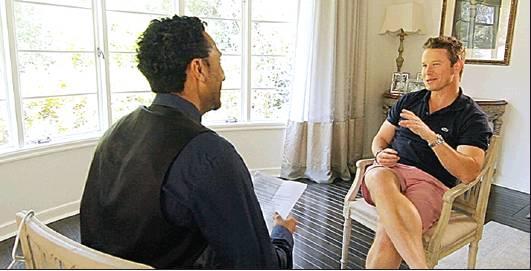
Cheney conducted more than 100 interviews during the course of filming. He spoke with everyday Americans who’ve confronted in one way or another the strain of paternal absence. He spoke with mental health professionals and other experts about the psychological effects of growing up without a father. And, as befits a director who cut his teeth as an assistant at “Access Hollywood,” Cheney has spiced his film with a cortege of A-list celebrities: Terry Crews, Aisha Tyler, Alan Thicke (whom Cheney sat down with only weeks before the famed TV dad’s untimely death), Billy Bush (the movie’s executive producer), and George Lopez. (So attuned was Cheney to the narrative cohesion of his documentary that he was willing to let an on-camera interview with Jerry Seinfeld hit the cutting room floor because it detracted from the film’s momentum.)
There are no favorite interviews, said Cheney — each person approached the question of fatherhood from a new and unique angle — but his conversation with comedian George Lopez struck an especially resonant chord.
“He was my last major interview,” recalled Cheney, who conceived of this documentary, though on a far smaller scale, while still a film student at Columbia College Hollywood. “I was supposed to have a 15-minute interview with George; his publicist was watching the clock. It turned into an hour and fifteen minutes. He opened up and shared some stuff that I don’t think he’s opened up to anybody about — because he was so passionate about the subject. His father left him when he was 2-months old and his grandmother raised him. He says so many amazing things, information that I think is really going to help and inspire young people.”

THE HOPE of inspiring young people is not a hollow concern with Cheney. “A Fatherless Generation” is precisely the film that might have helped smooth some of the wrinkles in the young filmmaker’s own early adulthood had it arrived a decade earlier.
Not long after his suicide attempt in California, Cheney returned to Iola. He needed work, and so joined the assembly line at Gates Corporation, his father’s longtime employer. The two men worked adjacent shifts. Arriving for work, Nathan would watch as his father departed the plant. It was the most consistent interaction the two men had had in years. “That was the beginning of me realizing that there was something there that I had to confront. … I started to see how hard my dad was working. My dad was and is to this day an extremely hard worker. To see that on a regular basis and to see life through his eyes, it really gave me a different perspective. I’d say that was the beginning of my understanding.”
That period also marked the beginning of Cheney’s career in film. Cheney, along with fellow IHS grad Chance Luttrell, created a short documentary, “Punch Clock,” which took as its subject the factory world of southeast Kansas. And it wasn’t long after shooting “Punch Clock” that Cheney learned he’d been accepted into film school in Los Angeles, a lifelong dream come true.
And yet, even while living in L.A., Cheney couldn’t help turning the facts of his upbringing over and over again in his mind. And so he did what any good artist does: he made of his obsession a virtue, and poured every ounce of energy into creating his first feature.
But the movie very nearly took a mournful turn. One day, while living in L.A., Cheney received a phone call from relatives back in Kansas. His father had been rushed to the hospital, his life hung in the balance. The prospect of losing a loved one, Cheney learned, has a way of concentrating the heart. “At that point, when I knew I might never see my dad again, I just thought, ‘Now is the time to talk to him.’”
Cheney spends the course of the film, as he’s spent the course of his life, on a quest to know his father. It’s this hunger for answers that sets up the high point to which “A Fatherless Generation” steadily builds. In the movie’s third and final act, Nathan at last sits down with his dad.
Cheney’s film provides a new and compelling gloss on what is a very old story — one of the oldest stories of all, in fact. The first four books of Homer’s “Odyssey” tell the story of 20-year-old Telemachus, son of Odysseus, who is engaged in a desperate search for his father. Odysseus abandoned the boy as an infant and Telemachus has reached manhood without ever knowing a paternal influence. The boy, Homer tells us, spent sleepless nights “tossing with anxious thoughts about his father,” his heart “obsessed with grief.” But by the end of the epic poem, father and son have found one another and, at the moment Odysseus walks through the front door, the two men fall weeping into each other’s arms.
“The tagline to the film is ‘A Journey to Forgiveness,’” said Cheney. “I set out at the beginning of this film as a very angry person, I set out with the idea that I’m going to conquer this thing called ‘manhood,’ I’m going to set out to be a man. The biggest lesson I learned in that process, though, was to redefine what that means. See, it takes a whole other type of man to forgive and move forward in life. To let go of grudges, to let go of the past, to find a way toward love.”
Cheney’s father has yet to see the finished film — he’ll see it for the first time with everyone else, in Kansas City — but by at least one measure it has already achieved a great success.
“This film,” said Cheney, “has brought us closer together, closer than we’ve ever been.”
This article originally appeared in The Iola Register on April 7, 2018. *
 RG danley