by RICK DANLEY // February 3, 2018
Forty years ago, a small boy in the remote hills of western Nepal waited with the men in his village to welcome the first motorized vehicle to ever enter their town. The approach was a slow one, the vehicle a tractor. When it arrived, the boy’s father and uncles took turns riding on the back of the spluttering machine.
The boy’s family wasn’t rich or even middle-class. His father was a subsistence farmer. The family grew rice and lentils and raised cattle and buffalo and goats. The boy’s parents had no formal education, but they recognized its value and sent all six of their children to the local school.
There was no electricity in the home, and so the children studied by the light of a kerosene lamp. When the kerosene ran out, they cut strips from a nearby Indian pine — known for its lambent and long-burning wood — and propped their books up near the light of the fire.
When the little boy was of a certain age, he and his brothers and sisters taught their mother to read and write. The boy was a teacher even then.
When he was in the fifth grade, a Peace Corps volunteer — a blonde-headed young woman from Kansas — arrived in the boy’s village to teach English. He was a good student and, because of that, he stood out. And she was a good teacher. Many decades later, when the two would reunite one afternoon in Kansas City, she would remember him. (Of course, at this point in the story the boy couldn’t have known that he himself would one day call Kansas home, even less that this early academic success would translate into his becoming one of this country’s premier nuclear physicists.)
And so the boy continued, throughout his schooldays, to show an appetite for knowledge, especially math and science, advancing from one institution of higher learning to another, until he found himself — no longer a little boy in the village but a scholar, Yadav Pandit — a lecturer at Kathmandu University.
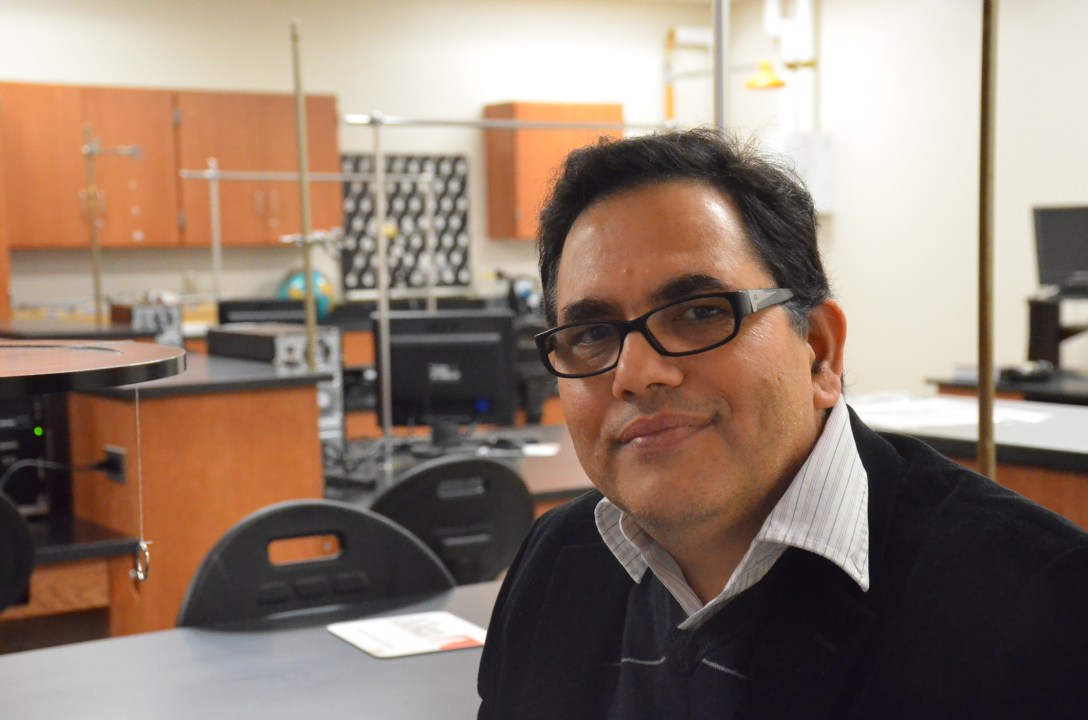
Pandit spent a decade teaching science in the capital city before it became clear that his intellectual ambitions had outgrown his surroundings. He applied to doctoral programs in the United States and received a scholarship to attend Kent State University.
It was at Kent State that Pandit began to carve out a place for himself in the field of experimental nuclear physics, and to initiate breakthroughs whose implications are still being assessed.
“Sometimes I try to explain to my son how it was for me growing up,” recalled Pandit, speaking earlier this week from his small office on the campus of Allen Community College, where he is the school’s physical science instructor. “He can hardly believe. It seems crazy to him.” Pandit’s eldest son is currently a senior at Blue Valley North High School, in Overland Park, and will be heading to Stanford University on a full-ride scholarship this fall.
“For me, too, it sounds crazy,” laughed Pandit. “But I did it, and that is my life.”
AND YET TO GAIN the full measure of Yadav Pandit, it’s not enough to go back to his youth. You have to go back to the beginning. As in the beginning beginning. As in the Big Bang.
OK, here we go….
The observable universe is made up of atoms. Each atom contains a nucleus around which one or more electrons orbit. Inside each nucleus are protons and neutrons, and each proton and neutron, in turn, is made up of itty-bitty elementary particles called quarks and gluons. These are, so far, the smallest particles known to experimental science.

Less than one second after the Big Bang — which is going back now about 13.8 billion years — the universe was instantly flooded with these free-floating, unbonded, subatomic particles — quarks and gluons. This quark-gluon mix, subjected to the extreme heat that accompanied the primary expansion of the universe, formed a dense plasma. This liquid-like substance is referred to, colloquially, as “hot quark soup.”
As the universe continued to cool, these tiny, free-floating particles began to combine, eventually becoming protons and neutrons. These protons and neutrons later combined to become atoms. And, in time, these atoms combined to form the very material of life.
At some point in the early history of the universe, then, this hot soup of subatomic particles was transformed into the ordinary matter of today’s world.
Just how this happened remains a mystery to science, and it’s this mystery which Pandit’s research is at pains to solve.
AFTER finishing his Ph.D. in 2012, Pandit signed on as a postdoc fellow at the University of Illinois-Chicago, where he remained for the next four years. During this period and in his final years at Kent State, Pandit made frequent, lengthy trips to the Brookhaven National Laboratory in Upton, N.Y., where he conducted extensive experimental research using the lab’s formidable Relativistic Heavy Ion Collider, or RHIC (pronounced “rick”).
RHIC is only one of two heavy-ion colliders ever built. Stephen Hawking has called these particle colliders — whose capacities allow physicists to recreate in a lab conditions similar to those just after the Big Bang — the closest thing humans have to a time machine.
The essential job of RHIC, then, is to shoot two gold-ion particle beams racing in opposite directions around a two-and-a-half mile underground track until they collide. The collision, which takes place at something approaching the speed of light, and which creates a temperature far in excess of that at the sun’s core, melts the protons and neutrons, and creates, on impact, an instance of hot quark soup.
Physicists are forever studying this fleeting plasma for any irregularities in the sudden conversion of atoms into liquid that might explain why and how matter first emerged out of this primordial soup — which is to say, why and how our universe was formed.
And Pandit’s work plumbs the very heart of this question.
Specifically, Pandit wants to find the critical point of that transition, when quarks went from free-floating to bonded.
And he’s off to good start: what he’s uncovered so far has been regarded internationally as a major breakthrough.
In 2014, Pandit and his co-authors delivered a paper showing that the phase transition from plasma to matter could also be defined as a first-order phase transition — and not an exclusive second-order transition, as prior science had assumed.
“Phase transition” or “phase change” are interchangeable scientific terms used to describe transitions between solid, liquid, gaseous or plasmic states of matter. Take a pot of boiling water: The steam rising from the bubbling water represents a phase transition — gas (steam) and liquid (water) being two phases of the same substance. A melting ice cube would be another example of a phase change.
In physics, a melted ice cube represents a first-order transition. The complete change in function — ice to water — seems abrupt; it jumps at a certain critical point from one phase to another.
A second-order transition, on the other hand, says Pandit, is smooth. He gives as an example a jar of honey removed from the freezer. Inside the freezer, the honey is solid; but when you place the jar on the table, it softens and liquefies. But, crucially, you can’t see the moment that it changes from solid to liquid; it doesn’t take place at a specific “melting point,” the change is continuous.
Pandit’s finding showing that the first-order jump from liquid plasma to nuclear matter — when the particle collision energy was lowered and the temperature cooled — marked a significant step forward in the field, and has prompted a number of exciting scientific discoveries in its wake.
Pandit remains a member of Brookhaven’s STAR collaboration team, which continues to probe the secrets of the early universe.
THE INTERNATIONAL renown that trails Pandit’s work is nice, but ACC’s real advantage in hiring Pandit derives from the 47-year-old’s cheerful passion for teaching.
Pandit spent most of his time at UIC bent over his research. But he missed teaching, and so he sought out a college or university that would again afford him that chance.
Pandit — whose surname, in Sanskrit, means “wise” or “learned” man — believes fiercely in the capacity of a good teacher to change lives. Pandit himself benefited from such a teacher.
“I believe if I had had a good commerce teacher or humanities teacher,” said Pandit, “my life might have gone in that direction.”
Instead, when Pandit was in the ninth grade, a patient, young science teacher, who’d arrived in Pandit’s village fresh out of college from India, instructed the boy in the special grandeur of science. Pandit always excelled in his math classes. And he was always good at science. But this young teacher showed the future physicist the precise connection between the two subjects. He showed him that math is, essentially, the language of science, and that forever changed Pandit’s life.
“I think to be a good teacher,” said Pandit, “two things are very important. The first thing is, you should love it. If you don’t love it, leave it. That is my suggestion. Everything else comes after that. Some people go into the teaching profession because they don’t find another job. That is a problem. See, teaching is completely different than any other job. Now, every person’s work is important — say, if you are an engineer or something, that is very important — but teaching immediately affects the life of others. Immediately. For example, if you have an experience with a bad teacher in some subject — say, you have a bad math teacher in the fourth grade — you may forever lose a key component in your life.
“The second important thing is to remember that nobody knows everything. Even though I’m a physics teacher, I don’t know everything about physics. So, you have to have a willingness to learn.
“To be a good teacher, you have to be a good student. Always. And then you have to love what you’re doing. These two things will make anyone a good teacher.”
IT’S HARD TO SAY exactly how Pandit went from being the boy beside the kerosene lamp in a small village in Nepal to the man working in the shadow of a 1,200-ton, multistory particle detector at Brookhaven. Was it because his parents valued education? Was it because of the young science teacher from India? Was it because he came to the U.S.? The process of change in Pandit’s life, as in anyone’s life, is more like melting honey than melting water. It’s opaque; it’s a process of continuous change. However, the passion and humility that inform Pandit’s philosophy of teaching must have something to do with the success of his journey. Surely, these are the same traits that make him an exceptional nuclear physicist, as they are the required traits for any person — any philosopher or religionist — who, each day, dares to stare into the invisible commotion of the universe and demand answers.
First published in The Iola Register on February 3, 2018. *
 RG danley