By RICK DANLEY // June 6, 2018
Billy Ray Hayes was born and raised on a Cherokee reservation in eastern Oklahoma. When he was old enough to join the service, the U.S. government shipped him to Hawaii. At the end of his military tenure, Billy Ray stayed on in Hawaii, but eventually his money dried up. “So I had to find other things to do,” said Billy Ray. He went from place to place, odd job to odd job. He wore a backpack. He adopted dreadlocks. Eventually, he made the acquaintance of the local Samoan community. “They accepted me like one of their own,” remembered Billy Ray.
One day, Billy Ray Hayes was sitting on the beach with one of the young Samoan women. He complained to the woman about his money woes. “Here, let me show you something,” she said. She took a single palm leaf and, with a few cryptic twists of her hands, she made a rose.
“Right then,” remembered Billy Ray, “I got it. And, after that, I was making all kinds of things with palm leaves, things would just come to me.” Flowers, grasshoppers, turtles, hearts, angel wings, crosses, hats, sandals, baskets. “See, I learned how to manipulate the leaf.”
“They gave me a gift,” says Billy Ray Hayes of the Samoans who taught the young wanderer the art of palm weaving. “And it is a gift.”
These days, the master weaver can spit out a rose, with its delicate scrunch of petals, in 30 seconds and he can manage a grasshopper — equipped with armored thorax, slim antennae, and cocked legs — in less than four minutes. His hands are a rough canvas of oddly-patterned calluses and he suffers already from symptoms of carpal tunnel. But he was granted talents of a special kind — Billy Ray is, there’s no other word for it, an artist — and he figures that these minor infirmities are simply nature’s cost. After more than 20 years of bending leaves, he knows full well that peddling palm-leaf figurines at farmers’ markets and craft shows and flea markets won’t make him a rich man, but Billy Ray Hayes says he doesn’t need to be a rich man. Billy Ray says he’s happy.
SOON AFTER Billy Ray returned to the mainland, he accompanied his father to the local Walmart. Billy Ray’s dad is also called Billy Ray. “That’s nice as a parlor trick,” said Billy Ray Sr. of Billy Ray Jr.’s prowess as a leaf weaver.
But Billy Ray Jr. knew that it was more than a parlor trick. He waited outside while his dad entered the store. By the time Billy Ray Sr. had finished his shopping, Billy Ray Jr. had already sold $200 worth of improvised palm-woven art.
“Well, OK,” conceded the older man, “I guess you’ve got yourself a job for your life.”
BILLY RAY — an immensely likable man with a carbonated personality, wide smile, Jim Croce mustache, and a do-rag covering a snake’s nest of thick dreadlocks — gave a demonstration of his folk art to a handful of local residents at the Iola Public Library Tuesday evening.
At one point, he looked down at a table scattered with browning palm leaves. “I’m not a pagan or anything,” he joked, “but, truly, these are my livelihood, these are my life.”
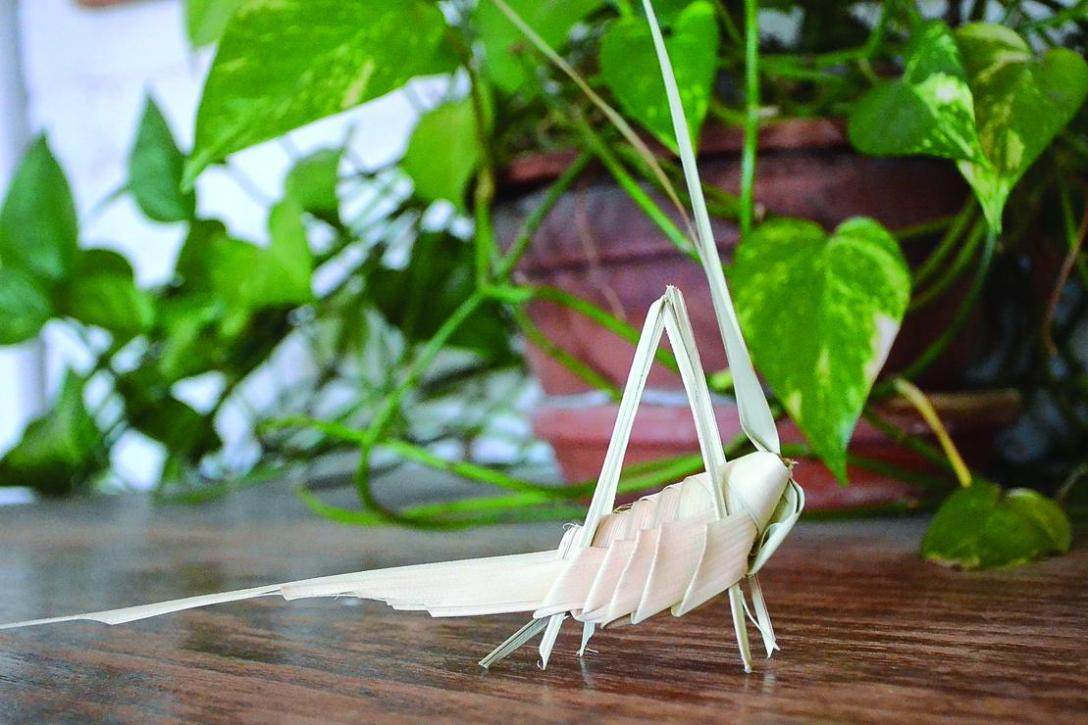
Billy Ray will sell you a rose for $3 or $4 or $5. Grasshoppers, depending on the size, retail for $5 or $6. But he’s worldly-wise, too, and applies a pricing system that wouldn’t be out of place in a Turkish bazaar: “You let the person tell you what they want to pay first. If somebody wants to give me $20 for a rose,” says Billy Ray Hayes, “who am I to say no.”
“But, like I said, I don’t do this for the money.” Billy Ray paused for a moment and tightened the stem on a rose and handed it to a woman in the second row. “You see, this is what I get out of it,” he said, “which is showing somebody something beautiful. I mean, I make flowers for a living — how cool is that?”
ACCORDING TO Billy Ray, the only thing that depresses him is when he runs out of leaves. You don’t order leaves, said Billy Ray, and you don’t just walk into a store and buy them. “You’ve got to earn them,” he said, “and I earn what I get.”
Here’s what that looks like in practice: When Billy Ray runs out of palm leaves, he will pile into his little red Volkswagen bug and drive down to Galveston, Texas, from Iola, where he is currently living with extended family. Once in Galveston, Billy Ray will return to his favorite swamp, where he has permission to cut from the biggest palm trees. He will cover his body in bug spray and climb, with a handsaw, 25 to 30 feet straight up into the center of a palm and return to land a short time later bearing an enormous emerald frond. Billy Ray will spend three to five days like this, collecting leaves, at which point he is ready to head back. But he can’t leave Galveston just yet; he first has to earn his gas money home.
But that’s easy enough for Billy Ray by now. The palm artist sets up outside a surf shop, Jungle Surf Shop on Porretto Beach, until he can sell enough roses and grasshoppers to earn his way back home. Down there, on the tourist-crowded strip, Billy Ray can make a $150 in an afternoon. After a couple of days vending his wares on the Gulf Coast, he gasses up and makes the long drive back — Billy Ray Hayes, one of the vernacular heroes of American life, a slender man in a little red bug, a smiling face behind the steering wheel, peeking out through a jungle of palm.
FOR A BOY from the ruddy steppes of Oklahoma, Billy Ray Hayes knows a lot about palm leaves. He can tell you the best way to preserve them (coat them in pectin, a preservative typically used in canning); he can tell you how to store them (he keeps his moist by stuffing them under his house); how to make them more pliable (steam them in the shower) or give them new life (soak them in a bathtub with vinegar and white sugar), and he can converse at length on the sacred and religious history of the palm leaf, which features heavily in the main iconography of so many ancient traditions, especially Christianity, where the palm branch represents Jesus’s heroic entry into Jerusalem.
It’s on account of this last fact that Billy Ray Hayes has made, in his two decades of palm weaving, a whole lot of crosses. The master weaver patiently showed a woman at Tuesday’s event how to make a simple Christian cross from a single leaf. Billy Ray then made another cross, this time with a rose wrapped around its beams. In fact, Billy Ray’s most ambitious project to date was a four-foot-tall cross interwoven with 36 hand-wrought roses that he made for the funeral of a little girl who’d died in a car accident. To this day, Billy Ray Hayes — who goes by a host of other names, too: “Gypsy,” “Billy Ray Jr.,” “Gypsy Ray Dogs,” and “Octopus Head” (“Dreads are not a hairstyle,” contends Billy Ray, “they’re a lifestyle.”) — to this day, any time Billy Ray passes a roadside memorial, he pulls his little car to the side of the highway and weaves a small cross of his own from a single palm leaf and rests it against the larger cross, a token, a small saltwater memory all the way from Galveston, Texas.
This article first appeared in The Iola Register on June 6, 2018. *
 RG danley