by RICK DANLEY // January 20, 2018
In 1890, fossil hunter Charles H. Sternberg — a little man with a high forehead and kind, close-set eyes — knelt alone atop a chalk outcrop in Western Kansas, and, with his pick and his brush and with the fervor of a man who’d been fossil-crazy since he’d arrived in the area from New York State as a boy of just 17, unearthed, vertebrae by vertebrae, the skeleton of a great prehistoric shark.
But it wasn’t just any shark. What the 40-year-old Sternberg uncovered was the King Kong of ancient sharks, Cretoxyrhina mantelli, the “Ginsu shark.”
Cretoxyrhina (creh-TOXsee-RYE-nah), which frequently grew to lengths of 25 feet and weighed close to 2,000 pounds, stalked the waters of the Western Interior Sea between 80 and 100 million years ago. Its rows of razor-sharp teeth and the bone-crunching power of its jaws made it one of the most formidable predators in an underwater ecosystem chock-full of formidable predators.
For millions of years, current-day Kansas was just another drenched patch of seabed below the Mesozoic water-route that stretched from the Arctic Circle to the Gulf of Mexico.
The brackish waters that churned above the Great Plains pullulated with exotic sealife. Giant clams. Giant squids. Giant turtles. A miscellany of ancient sharks. An aggressive 20-foot-long fang-toothed fish, Xiphactinus, whose upturned jaw lent it the look of a bulldog. And then, of course, there were the enormous marine reptiles — the long-necked plesiosaur, say, or the mosasaur, whose sleek body and deadly jaws gave it the hybrid appearance of a shark crossed with a T. rex. Pteranodons, with their long beaks, anvil-shaped heads and bony wings, skimmed the surface of the ocean in search of fish, and counted, among their competition in the food chain, several species of marine birds whose beaks were pebbled with rows of teeth.
This is to say nothing of the land bordering the inland sea, where dinosaurs, mastodons, short-limbed rhinoceri, saber-toothed tigers, and deers that were barely 12-inches tall moved through forests thick with ferns and conifers and the era’s other immense variety of flora.
But then, like that — which is to say over the course of many millions of years — the land beneath the Western Interior Sea lifted, and the ocean receded to its present shorelines.
Early on in his memoir, “Life of a Fossil Hunter” (1909), Sternberg casts his fancy back to the ecological Xanadu that once lay across the great Midwest.
“How often in imagination I have rolled back the years and pictured central Kansas, now raised two thousand feet above the sea, as a group of islands scattered about in a semi-tropical sea! There are no frosts and few insect pests to mar the foliage of the great forests that grow along its shores, and the ripe leaves fall gently into the sand, to be covered up by an incoming tide and to form impressions and counterparts of themselves as perfect as if a Divine hand had stamped them in yielding wax.”
AND THE WAX, 125 years after Sternberg made his big find, is still yielding. “In fact, because so much stuff, even today, comes out of Kansas, it’s hard to keep up on the latest fossil findings,” said Ian Trevethan, a paleontologist from Fort Hays State University’s Sternberg Museum of Natural History, who was in Iola earlier this week as part of SAFE BASE’s third annual Shark Week. “The really cool thing about our state is that we have lots of fossils from all different ages. We actually have one of the best continuous rock units that yields that kind of material.”
Once again, USD 257’s enterprising afterschool program is educating and entertaining its charges with a menu of “fin-tastic” festivities, which will continue through the first part of next week. The focus this year? Prehistoric sharks.
And if there is a single mascot for Shark Week, it is Sternberg’s Cretoxyrhina, a life-size drawing of which hangs in the Jefferson Elementary School gym.
ON WEDNESDAY, Trevethan addressed a roomful of SAFE BASE kids. The students, many as young as five or six, crowded into the Iola High School lecture hall to listen to the scientist speak.
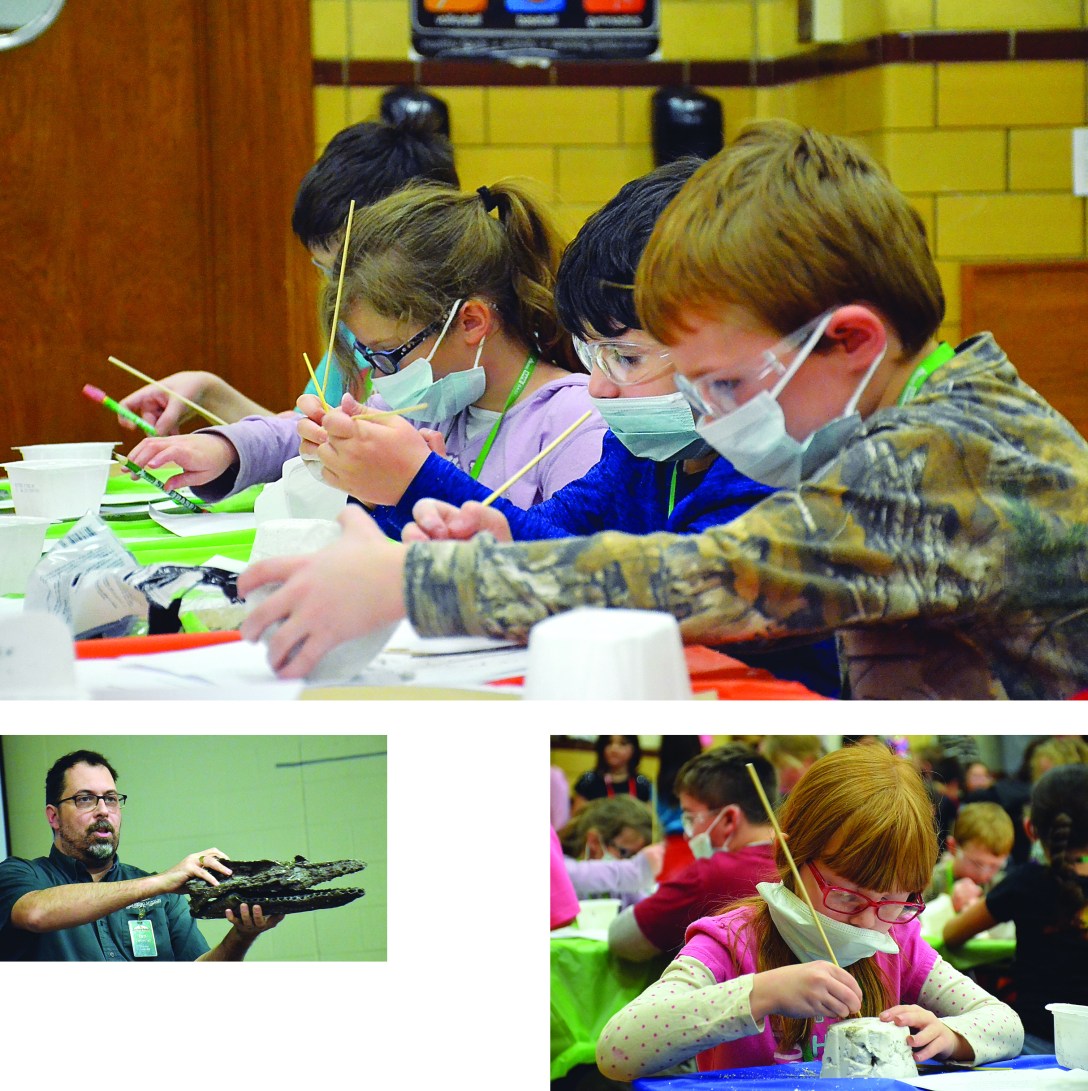
Trevethan, whose research focus is the isotopic analysis of core body temperature in mosasaurs and the significance of cranial variations in dinosaurs, toned it down for the kindergarten set.
“One thing that a paleontologist has to think about is time,” Trevethan told the students. “Have you ever thought about time?”
“Yes!” they all shouted.
“How many of you can count to 10?” asked Trevethan.
All of the kids raised their hands.
“How many of you can count to 50?” The hands went up again.
“100?” Again, most of the hands in the room went up.
“1,000?” Same amount of hands.
“Can you count to a million?” asked Trevethan. This time, somehow, even more small hands shot up. “Can you count to 10 million?” Their hands remained aloft. “I love to count to 10 million!” boasted one little girl. “OK, you guys are making stuff up now,” said Trevethan. “How about a billion?” “Yes!” they insisted, and a dozen additional arms were raised. One clear-eyed boy of 5 or 6, though, was having none of it. He leaned across the armrest toward his friend: “Put your hand down.”
Trevethan went on to tell them about time’s effect on the planet’s geology. He told them about the three types of rock in which fossils are found.
There is igneous rock, he said, which is basically cooled lava.
There is metamorphic rock. “Now, metamorphic rock,” explained Trevethan, “is rock that used to be one kind of rock but got squished down and heated up over a period of time and turned into something else. Marble is an example of a metamorphic rock. When limestone is heated up and compressed, it turns into marble. Did you know that?”
A little girl in the front row, whose bangs hung over her eyes and whose feet didn’t reach the floor, told Trevethan, coolly, “Yeah.”
And then there is sedimentary rock, continued the paleontologist, naming the three subtypes — sandstone, mudstone and limestone. “Sandstone is made of what?” asked Trevethan. “Sand!” shouted the students in unison. “Mudstone is made of what?” he asked. “Mud!” they shouted. “And limestone is made of what?” “Limes!”
THURSDAY’S event was more hands-on. Trevethan was back. He took small groups of SAFE BASE’s older students — third- through sixth-graders — and seated them at two tables in the art room at Jefferson Elementary. On each table was a replica skeleton embedded in a slab of faux rock. The students were invited to slip into the figurative khakis of a real-life fossil hunter and determine, based on a thorough review of the specimen that lay before them, what sort of creature they were looking at, where it lived, and how it might have met its demise.
Combining their clues and relying on no small amount of help from Trevethan, the students realized that they possessed the remains of two unique prehistoric beasts.
The first pile of remains told of a small mosasaur, whose skull had been punctured by the teeth of a larger mosasaur and whose carcass was subsequently set upon by local sharks, including the large Cretoxyrhina.
The second specimen depicted a duckbill dinosaur, who had been attacked by a pack of velociraptors. The evidence of the ambush was the heavy sprinkling of raptor teeth that surrounded the dino’s bones.
Meanwhile, in the school’s gymnasium, SAFE BASE’s youngest paleontologists were bent over a similar, if less grisly, task.
Under the direction of SAFE BASE director Angela Henry, each student was given their own piece of prehistoric rock. The “rock” in this case was a small, hard plaster or else sandstone mound, each the size and shape of a miniature bundt cake, inside of which were hidden sharks’ teeth or else small toy sharks.
Outfitted with safety glasses and paper masks and brushes and awls, the students set upon their rocks with Sternbergian energy. Some kids took the care of a bomb disposal agent in prising apart their rocks. Others banged their rocks with repeated force against the tabletop until small fissures appeared in the plaster. Once the small fissures were in evidence, they banged some more.
In every case, the students cheered their findings.
CHARLES Sternberg was a young person himself when he made up his mind to chase fossils. “[W]hatever it might cost me in privation, danger, and solitude,” determined the teenage Sternberg, “I would make it my business to collect facts from the crust of the earth….” Sternberg endured heat and thirst and disease, “forgetting everything but the one great object of my life — to secure from the crumbling strata of this old ocean bed the fossil remains of the fauna of Cretaceous Times.”
Late in his memoirs, Sternberg recalls, as a young man, his enthusiasm at stumbling upon what appeared to be the largest bone bed in Kansas. He quickly, “in the name of Science,” set upon the sandstone with his pick without first inquiring whether anyone else had an interest in the land.
While Sternberg clawed away with his tools, an old man, plowing corn, drove up to the edge of the ravine in which the paleontologist was working.
The old man shouted with all the strength of his lungs. “What are you doing?”
Sternberg cheerfully lifted his head. “Digging up antediluvian relics!” he shouted back.
“Well,” the confused old farmer called back, “get out of there!”
“All right,” Sternberg yelled, and then kept on working.
Sternberg would go on to become world-famous in his field. In the winter of 1906, he was honored at a celebration at the American Museum of Natural History, in New York. Sometime after the event, Sternberg wandered outdoors alone.
“It was a glorious thought to me that I have lived to see my wildest dreams come true… [My] heart swelled with pride when I looked down on that teeming metropolis and remembered that I too was a native of the Empire State. Then I thought of my distant prairie state of Kansas, and gloried in the thought that the best years of my life had been spent in her ancient ocean and lake beds, those old cemeteries of creation.”
This article originally appeared in The Iola Register on January 20, 2018. *
 RG danley