Painting tucked away in Iola bank vault could be worth $500K
by RICK DANLEY // May 29, 2018
In January of 1922, nearly thirty years after swapping his native Sweden for the rolling plains of central Kansas, the painter Birger Sandzén received his first one-man show in New York City.
To this day, that exhibition at the Babcock Gallery, which revealed Sandzén at the very pinnacle of his creative powers, is considered the most prestigious show in the artist’s long career.
The audacities of technique and style that he’d absorbed from the European modernists and then applied to the New World landscape of his adopted Midwest — namely, the radical use of impasto, the vivid brushwork, the rippled surfaces, the liberation from strict realism, and, above everything else, the rich coloration — produced a newness of vision that forced the wider art world to take notice of this polite, middle-aged art professor from Lindsborg, Kansas.
Sandzén would likely have come to the attention of the metropolitan tastemakers at some point anyway. He’d staged a successful one-man show in Washington D.C. just two years earlier, and he had a small but devoted band of fans in the New York art world urging the Swedish-American painter to take his rightful seat at the banquet table of Great Art.
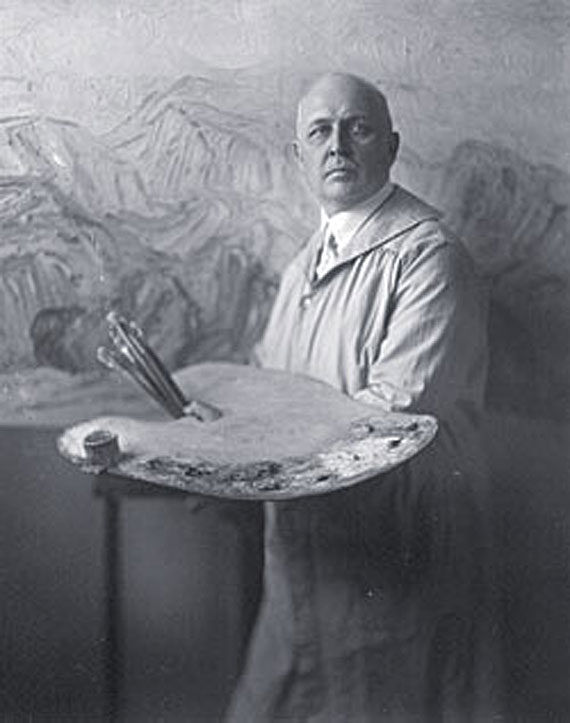
And yet it was, at least according to Sandzén’s biographer, on the strength of one painting alone — a painting titled “Autumn, Smoky River, Kansas” (1921) — that the Babcock show was launched.
The painting, a large golden-evening pastoral done in effulgent pinks and blues and greens and violets, in which the paint is applied to the canvas as thickly and lusciously as cake frosting, was owned by a man named Ernest Davis, a world-renowned opera singer living in New York. Davis was a friend of gallery owner Edmund C. Babcock, and it was Babcock who first spotted the Sandzén painting while visiting Davis’s Manhattan home. The gallery owner was immediately impressed, and in a few weeks’ time he’d arranged for Sandzén’s paintings to decorate the walls of his gallery.
The show was a hit. “Birger Sandzén is a solitary who sits on a far-off mountain peak, enveloped in sunshine,” wrote one European reviewer in prose as impastoed as his subject’s paintings. “This dreamer-painter is truly a master.”
The exhibition catalog lists 20 watercolors, 13 woodcuts, 40 lithographs, and 31 oil paintings. The oils range across Sandzén’s career, from a twilit painting of the Grand Canyon in 1915 to the show’s final listing, “Autumn, Smoky River, Kansas” (1921). “Lent,” the catalog specifies of this last piece, “by Mr. Ernest Davis.”
IN THE LATE FALL of 1966, more than forty years after the luminescent Babcock show, a letter landed in Ernest Davis’s mailbox. Davis was an old man by then, living in a little plant-shaded bungalow on the St. Lucie River in southeast Florida. The letter was from a Mr. Raymond D. Smith, who identified himself as the school board president in Iola, Kansas.
“Dear Mr. Davis,” the letter began, “Mrs. C.E. Russell of Iola has visited with me recently relative to your willingness and desire to make a most welcome gift to the Board of Education of the Iola school system of a valuable painting by Birger Sandzén….”
Davis, whose singing career ended three decades earlier when disease stole his eyesight, must have had the letter read to him aloud.
Smith continued: “You could not have known about this, but one of the things we have discussed frequently and thought to be an important and necessary addition to the Fine Arts Center is a permanent art collection…. Your donation of a Sandzén will be the first of this collection, and it quite possibly will be the spark that is needed to start an impressive collection of art to be enjoyed and appreciated by the entire community. … It is difficult to convey to you, Mr. Davis, the real expression of gratitude and appreciation the Board of Education feels upon learning of your generous offer.”
Smith went on to extend his gratitude on behalf of all the residents of Iola and the surrounding community, signing himself, “Gratefully Yours, Raymond D. Smith.”
Ernest Davis died five years later, at age 86, and the painting, “Autumn, Smoky River, Kansas,” was, as promised, packaged and shipped to the Bowlus Fine Arts Center, in whose possession it remains.
II. But, listen — you want to hear about the money
In 1966, when Raymond Smith described the Sandzén painting as “valuable,” it might have attracted a couple thousand dollars at an art sale. In 1984, the oil painting — whose precise title and year were, until last week, unknown — was appraised at between $12,000 and $16,000. In 1991, speculation was that the painting was worth $20,000.
Today, according to the most recent appraisal, the Bowlus Fine Arts Center is in possession of an oil painting valued at anywhere between $300,000 and $500,000.
The last appraisal was conducted in 2016; it may be worth more today. “What we’ve seen,” said Ron Michael, the director of the Birger Sandzén Memorial Gallery in Lindsborg, “is that the Sandzén works done in the late-teens and early 1920s retain or increase their value, and that the works that are most sought after are from that time period.”
Sandzén’s work, which during the first part of his career obeyed the conventional dictates of color and form, underwent a revolution in style at the start of the new century.
In 1905, the émigré artist took a yearlong sabbatical from his teaching duties at Bethany College. He packed up his brushes and paintbox and kissed his Lindsborg friends adieu, and he set out across Europe in search of fresh influence — Copenhagen, Berlin, Munich, Venice, Florence, Rome, Madrid, Paris.
He returned, in 1906, a changed man. Or at least a changed artist. “In fact,” explained Michael, “there are letters in the archives that describe Sandzén burning his older work when he got back, and beginning new things. And you can see it — there’s much more vigorous brushwork and much richer coloration. For a short time after he returned, Sandzén did almost purely pointillist work. He then moved out of that and into even lighter coloration, with broader brushwork, but then he really exploded in 1917 with very heavy impasto brushwork and deeper, richer color.”
And it’s out of the kiln of this new, richer style that the Bowlus’s painting was forged. “In this painting, there’s a heavy application of paint and the colors are very rich and vibrant,” continued Michael. “A lot of purples and dark blues and oranges. To me, the really deep, rich colors that you see in those early ‘20s paintings are the culmination of Sandzén’s most interesting work. And [the Bowlus’s] painting represents that extremely well.”
This makes the 36” x 48” “Autumn, Smoky River, Kansas” one of the artist’s major paintings. “I would say it’s in the upper 10 or 15 percent of Sandzén’s work,” said Michael.
There is also, among the lush paintwork and intense coloration, an extra ornament of aesthetic significance that hovers among the picture’s other essential delights.
“The painting,” said Michael, “shows what appears to be a moon.”
A moon?
“A moon,” said Michael. “For some reason, we’ve seen that people really like to collect paintings that have moons in them, paintings with that twilight feel.”
And so, besides marking the stylistic high point of Sandzén’s career, the Bowlus’s oil invokes the tableau at the very center of the artist’s imaginative life. Even the introduction to the 1922 Babcock catalog pauses to reflect on “the suffused glow of evening, with the moon stealing up behind the scattered cottonwood trees” at the heart of Sandzén’s work, calling it “the first artistic motif that Sandzén made definitely his own,” his personal “aesthetic microcosm.”
III. So you’ve got yourself a Sandzén…
Members of the Iola board of education, who operate as trustees of the Bowlus Center, have a choice on their hands: Keep the painting or sell it?
The first option presents an immediate problem. Without significant and costly improvements to the climate-control system and without beefing up the building’s security system, the Bowlus Fine Arts Center, with its mostly basement-level conditions, is not properly equipped to care for or display an artwork of that vintage.
As it stands, the painting — which, for years before its large value was ascertained, hung in the director’s office — has already sustained the usual amount of minor wear and is currently en route to a professional conservator’s in Denver, where it will undergo a lengthy $6,000 to $8,000 restoration.
Since 2012, the oil painting has remained — except for occasional guest appearances at various Sandzén exhibitions across the region and infrequent appearances in the Bowlus’s Mary L. Martin Gallery — in safekeeping in an area bank vault.
“It would be hard to see it go,” said Susan Raines, the art center’s director. “I think it’s just a stunning piece, and it’s wonderful that the Bowlus has owned it. But when it’s not possible for us to display it — I mean, to me, art is meant to be seen and enjoyed.”
For the Bowlus to display the piece in its current facilities, said Raines, would be to contribute to the deterioration of the painting. “When you look at that, you just think, ‘You’re not the best owner of the painting.’ And to keep it in a bank vault is just too sad. … The artist is no longer living but that doesn’t mean that you don’t honor and respect the art that he did. So, in this case, you have to consider, one, the artist and his work, but also what will come from the income off the painting for the Bowlus in the long term.”
WHICH TOUCHES on the district’s other option: selling the Sandzén.
USD 257 isn’t the first school district burdened with this happy dilemma. Sandzén and his local art dealer, Carl Smalley, were great believers in arts education and donated, or else sold at steep discounts, a number of paintings to school districts across the state.
In 2007, the Kansas City, Kan., school board faced the choice of selling two Sandzén oil paintings gifted to Wyandotte High School in the early part of last century. The board chose not to sell the paintings — worth a combined $195,000 — and today they’re on display in the district’s central office. School districts in McPherson and Pratt, ill equipped to care for their Sandzéns, entered into loan agreements with local qualified museums. In 2010, the Hoisington school district sold at auction two Sandzén oil paintings and one watercolor for a total of $171,500. The district has since used the interest on the proceeds from that sale to fund student scholarships.
In Hiawatha, the school board voted unanimously to sell their three Birger Sandzén oil paintings. The decision earned the district $530,000. That was in 2008. The board placed the proceeds from the sale into a certificate of deposit and earmarked the money for the exclusive use of the arts. According to a phone conversation with school officials on Thursday, the district has plans this year to use the funds to improve the high school auditorium, where Hiawatha holds its concerts, plays, musicals, and other arts-related events.
The better example, however, may be a recent case in Wisconsin. Nearly 15 years ago, two large Sandzén oil paintings were disinterred from a dusty boiler room in a Milwaukee high school. Last summer, one of these paintings — whose pre-auction estimate stood at $300,000 to $500,000 — sold for $516,500, making it the third-highest price ever paid for a Sandzén. (The record for a Sandzén oil is $670,000, achieved two years ago at an auction in Dallas for a painting the artist completed in that very vibrant year of 1921.) The Milwaukee school district dedicated the $771,000 in total proceeds garnered from the two Sandzén paintings to a scholarship fund.
It should be said that for districts that have chosen to sell their Sandzéns there are other, material ways to honor the specific nature of the donor’s gift. The Hoisington school district, for example, after the sale of their three paintings, arranged for the auction house to send back large, high-quality photographic reproductions of the artwork. And, last year, I spoke with the dynamic young director of Topeka-based ARTSConnect, Sarah Carkhuff Fizell, who floated the idea of reproducing the Bowlus’s landscape painting as a public mural. You wouldn’t need a street-level Sandzén to sketch the piece; the technology is there to magnify the image onto any clean wall, at which point a competent fill-in artist could attack the job.
IF USD 257 does choose to sell its oil painting, it will of course inherit an additional question: what to do with the money.
That, too, is up to the school board. Raines, however, who has kept close tabs on the escalating Sandzén market and has made every effort to preserve the integrity of the painting since learning of its rare value, hopes that the proceeds secured from any potential sale of the painting will be invested in the corpus fund of the fine arts center. “When you look at paying $6,000 to $8,000 for restoration,” said Raines, “[the proceeds from the sale of the Sandzén] could very easily make that much money back in one year’s time invested, if not a lot more. There are opportunities here long-term for the Bowlus if that money is made part of the permanent endowment, and I’m hoping that that is what the board will decide to do. The goal is to sustain the Bowlus, because, to me, this building itself is a piece of art.”
Furthermore, it is in line with the original spirit of the gift.
Sandzén himself, besides donating more than 100 paintings to school districts across the state, was known to give away his own paint tubes and canvases to students who were too poor to buy their own supplies. A 1988 article in the Kansas City Star quotes one of those students: “He dedicated his life to promoting art — all art, not just his own.”
It’s perhaps fitting, then, that the last guests the great artist received in his study shortly before his death were school children.
III. To Ernest
Ernest Davis was regarded as one of the great opera tenors of the day. He performed with the Metropolitan Opera, the Boston Grand Opera Company, the Chicago Opera Company. He sang in Carnegie Hall with the New York Symphony Orchestra. He once appeared before 18,000 fans in a concert stadium in New York. He toured Europe, charming audiences in London and Rome. He was said to have the lyric qualities of a great Irish tenor like John McCormack and the volume of a Caruso. He was Radamès in “Aida,” Manrico in “Il Trovatore,” Turiddu in “Cavalleria,” the Duke in “Rigoletto,” he was Faust in “Faust.”
But before he was any of these things, he was, as one big-city newspaper dubbed him, a simple “plough-boy from Coffey County.”
Born in Le Roy in 1884, Davis moved to Iola with his family when he was a teenager. It was here that he took up singing. And it was here, too, that he met Nellie Ruxton, an apple-cheeked girl from Mildred. The two married in 1903. Neither was yet 20 years old.
Talent-spotted by the music director of his Iola church, Davis was encouraged to enroll at Bethany College to make a serious study of voice. It was there, in Lindsborg, that the Davises first became acquainted with Birger Sandzén. During the day, while Ernest fine-tuned his bel canto, Nellie studied painting under the great Swede and later worked as an assistant in Sandzén’s studio.
But soon the world’s major opera directors came knocking and the plough-boy and his bride were whisked off to Chicago, Boston, New York, Paris, Rome, where they spent the next few years sipping from the upper air of the international beau monde.
As a young man, Davis was recognized for his “magnificent physique.” He was broad-chested, with a thick wedge of dark hair; he had a strong, aquiline nose and a gently smiling, downturned mouth. But the press routinely commented, too, on Davis’s kind nature. “He is a sympathetic, modest young artist,” reported one German newspaper. On a return visit to his home state in 1922, another reporter observed that he was “still the Ernest Davis that Kansas… knew: kindly, genial, smiling, and not puffed up.”
But being kind is no armor against life. At the height of Davis’s career, heartbreak intruded. In 1920, his wife Nellie died suddenly at the age of 36. Two years later, the Davises’ only child, a son, Ernest Davis Jr., died on the operating table after complications from surgery. He was 7.
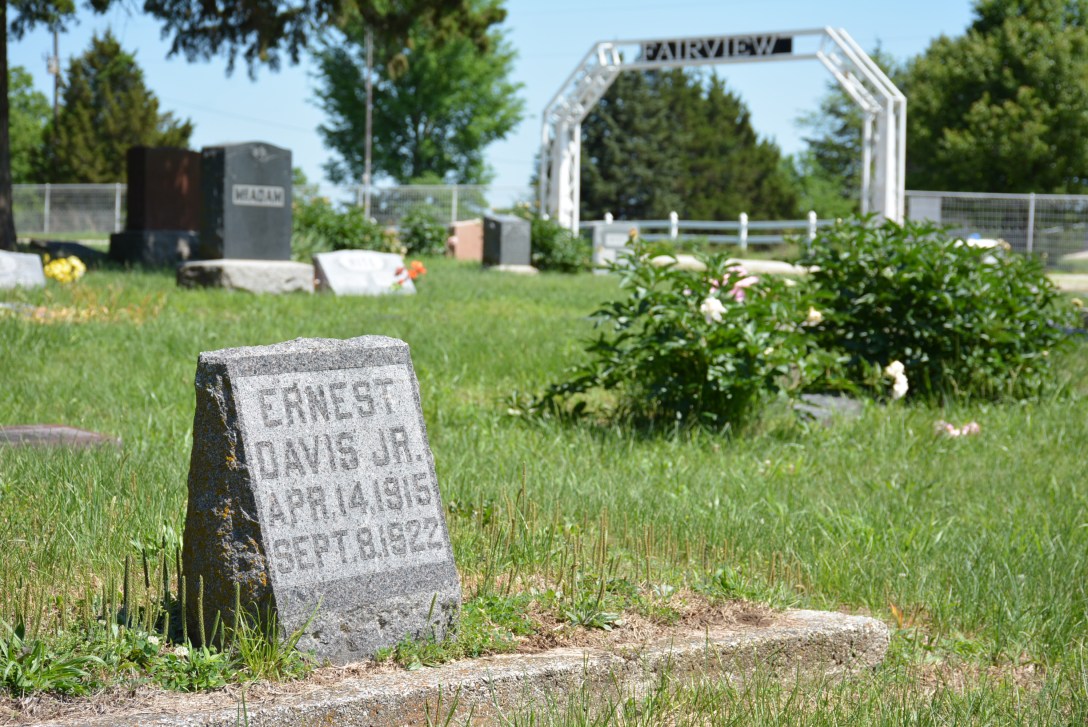
Nellie and Ernest Jr. — this young woman from Mildred, and this little boy who knew nothing of Kansas, who was born in Chicago and who died in New York City — today lay beside one another in sloped graves on the south side of Fairview Cemetery in rural Allen County.
Tragedy is the great subject of opera, and so perhaps it’s too neat to suggest that it was also the great subject of this opera star’s life. But we don’t know that for sure; we don’t know what became of Davis’s life. Except this: In 1929, while on a European concert tour, a doctor in Berlin told the young tenor that he would be completely blind in three years’ time. And we know that it was this that eventually drove Davis from the stage.
He appeared very occasionally in the years following his diagnosis, including in a homecoming trip to Iola, where he sang “In the Garden of My Heart” and “My Wild Irish Rose” to a gathering of about 3,000 in the park.
Soon after, he and his second wife, Mabel, started a piano tuning and repair business in New York, which they operated until 1959, when the pair retired to Florida. Not much else about Davis is known.
And neither is it recorded just why he chose to send the Sandzén to Iola, except that for a time it was his old hometown. Perhaps, like Sandzén, with whom he stayed in touch until the painter’s death in 1954, Davis believed that Kansans could use the reminder that the arts are not a superfluous thing, that they are not the province of a select group, that they are as much the plough-boy’s birthright as they are the professor’s. And who better to help dissolve that prejudice than Birger Sandzén, who, as one reporter in the 1930s put it, “has done more, probably, than any other one Kansan to dispel the pioneer suspicion of beautiful things.”
This article first appeared in The Iola Register on May 29, 2018. *
 RG danley