by RICK DANLEY // September 1, 2018
On the afternoon of Jan. 29, 2005, Josh Boyd was helping his dad put up a horse barn at his grandma’s place outside Los Lunas, New Mexico. The two worked for hours in the crisp, high-desert air. After a while, Boyd abandoned his tools. “I’ll be back soon,” he told his dad. “I have one last horse to ride.” The 29-year-old jockey had been riding racehorses for nearly half his life at that point and was one of the region’s top riders, and so pausing in the course of a day to board a big-money horse was not an unusual adventure for Boyd.
As he was leaving, his grandmother came out to say goodbye. “When are you coming back?” she asked. “I’ve got one last horse to ride,” he told her, “I’ll be back soon,” and then he and his fiancée, Ashley, piled into his truck and the two drove three hours south to Sunland Park, where Boyd was scheduled to appear in a race the next afternoon.
SUNLAND PARK CASINO & RACETRACK is one of the oldest racetracks in the Southwest. In fact, the town of Sunland Park itself, which borders El Paso to the east and Chihuahua, Mexico, to the south, takes its name from the venue and continues to depend on the track as an important source of revenue.
Boyd arrived early on race day. It was a Sunday afternoon. He was scheduled to ride in the seventh race, a claiming heat reserved for 3-year-old thoroughbred maidens.
It would be a light day for Boyd. In his ten years as a professional jockey, Boyd would sometimes ride seven, eight, nine horses in a single day. One horse was a piece of cake. Over and done.
Boyd changed into his silks and then met with the horse’s trainer near the stables. That day’s horse, Cuervo Brown, had suffered a minor leg injury a few weeks back, and the two men, Boyd and the trainer, had decided to rest the horse between meets and ease him back into a raceable condition. The Sunland Park race would be Cuervo Brown’s first race back.
As is customary in every race, Boyd took his horse for a few brief turns around the grounds. This allowed the horse to warm up. It also allowed Boyd to assess the horse’s overall fitness. Even through post parade, when riders take their horses from the paddock to the gates, letting the animals pass before the grandstands, Cuervo Brown felt as solid as any other healthy horse.
The announcer gave the call, and horse and jockey loaded into the gate. The weather that day was perfect; a mild chill in the air, the sky a cloudless dome of brilliant blue.
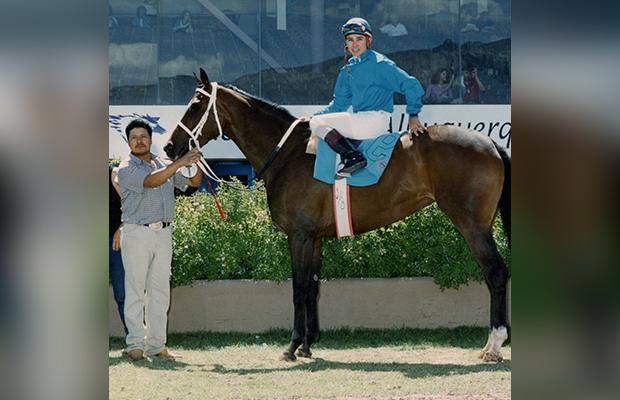
Boyd’s memory of that afternoon is fuzzy but he doesn’t recall anything unusual about his horse’s temper after loading him into the starting stall. But the pedigree report on Cuervo Brown, published after the race, says something slightly different. It describes the horse as being “fractious in gate.” This is the same post-mortem report that tells readers that Cuervo Brown, immediately after this race, was “vanned off & euthanized.”
It was a three-quarter-mile race. Cuervo Brown came out of the gate strong. The horses were in a pack as they passed the quarter pole, and they remained bunched as they entered the homestretch. Still, Boyd had good position. Thoroughbreds at this level of competition average about 40 mph on the track, and this is the point in the race when riders are opening their throttles. Boyd remained center-perched above the horse, the rumble of hoofbeats thundered in his ears. He advanced on the other riders. But then it happened: Boyd passed through a waiting door and into that shaded antechamber where a person’s life divides neatly into everything that happened before and all that will come after.
Just inside the track’s quarter mark, Cuervo Brown’s right front leg snaps in two. Boyd is thrown from the saddle. He hits the ground and immediately tumbles beneath the number six horse, who rolls the fallen rider beneath all four hooves, spitting Boyd out like a rag doll and landing him, improbably, on his hands and knees. Boyd seems about to get up, but there’s no time. At this moment, the final trailing horse, New Car Caviar, crashes into Boyd at full speed, driving his knee bone directly into Boyd’s head, crushing the rider’s right temple.
Cuervo Brown, on the other hand, stays up for a few fleeting seconds, hopping on three legs, confused, frightened, his ruined foreleg, below the knee, flaps wildly back and forth in the air, as useless as an empty sock. The horse looks down at it and then up again, and then down again, before sinking to the ground.
It’s an almost perverse point of pride in the jockey world to remind the casual race fan that horse racing is the only professional sport in which an ambulance chases its athletes. But it’s not untrue. At every race, after the horses leave the gates, an emergency vehicle pulls onto the track and trails the animals at a short distance.
The Sunland Park ambulance is at Boyd’s side in seconds. Ashley, who’s been watching all of this from the grandstands, races toward Boyd. The crowd lets her through. She’s there beside him. Boyd is still coherent, barely, but not sure what’s happening. He doesn’t understand the extent of his own injuries at this point. No one does. He’s complaining about a pain in his leg. And he’s asking about the dirt and blood that are caking his mouth and nostrils. Paramedics stabilize the rider as best they can and load him into the ambulance. They tell Ashley to follow them to the nearest trauma center, in El Paso. Ashley calls Boyd’s parents from the road to explain what’s happened to their son, and they too light out for the far tip of West Texas.
AT THOMASON GENERAL HOSPITAL, Boyd is rushed into emergency brain surgery, where it’s discovered that his skull is fractured in eight places and that he has close to a hundred fractures up and down the right side of his face. Doctors immediately remove a portion of his brain’s frontal lobe and cut a tablespoon-size chunk from his right-side temporal lobe, which was damaged irreparably by the direct impact. The force of the trauma also dislocated Boyd’s right eyeball and severed the optic nerve on the same side, rendering him blind in that eye.
Like most high-risk brain surgeries, Boyd’s was an uncertain success. During the surgery, Boyd suffered one stroke and then, minutes late, another, and so doctors had no choice but to immediately plunge him into a medically-induced coma, where he lay — all 5-foot-1 of him, all 110 pounds; a dream size for a jockey — for more than a month.
During this period of enforced sleep, Boyd’s prognosis remained unknown. Doctors warned that, if he did wake up, he might be paralyzed for life. Local newspapers in El Paso and in Albuquerque reported on Boyd’s accident and on his unsettled progress. Even members of an online forum at a site called Pedigreequery.com felt free to speculate on Boyd’s condition. As late as Feb. 14, one member, identified as “brooke,” wrote: “Josh was supposed to ride my [quarter horse] colt this past weekend end [sic]. right now he is in a induced coma (however you spell it) They really dont think he is going to make it. He has ridden for the farm i work for ever since he got his first start. really nice guy and quite talented with both [thoroughbreds] and [quarter horses].”
Another post, by someone called “surprisewind,” rushes in to correct the record: “The last I heard a few days ago was that he is OUT of the medication induced coma, but due for another surgery. His mother is a nurse (i think at the hospital) and was not optimistic about his recovery -said if he did wake up he’d not be himself ever again. There was serious frontal lobe damage along with the injury to his eye (regaining his sight is still up in the air). BUT a few days ago, he was up talking, recognized people, and had gone back to being a bit of a smart-ass 🙂 …His riding career IS kaput but his prognosis is markedly different from Brooke’s post.”
THE TRUTH is that Boyd’s mother was in the medical field — she taught emergency medicine at the University of New Mexico — but was never a nurse in El Paso. She also happened to be the rock in Boyd’s life at that time, and remained by his side for the duration of his stay in the hospital. She’d lost her only other son in a tractor-trailer accident two years before. She wasn’t prepared to lose another.
The jockey colony, like any enclosed world that has its own language and operates by a system of private rituals, is a community loyal to its own. After a jockey wins his first race — after he “breaks his maiden,” as they say — his fellow riders greet him with an elaborate hazing ceremony. And of course there’s gossip among jockeys, same as anywhere else. Jockeys know the good trainers from the bad. They know which of their fellow riders are “flippers” — those jockeys who make a habit of throwing up after each meal in an effort to maintain their riding weight. And when a rider goes down or is killed, they bear, collectively, the weight of that grief.
THEY SAID, in those weeks following Boyd’s accident, that J.R. “Jimmy” Coates slept with a pistol by his bed. It was Coates’s horse that crashed into Boyd. Coates told a few people that if Boyd died, he was going to end his own life. It was all too much to bear. He had played that moment over and over in his head. He told everybody that he’d pulled up on the reins but that his horse, that New Car Caviar, wouldn’t budge. He’d pulled up hard, he told them. Why hadn’t the horse veered? Why hadn’t he even slowed down? But Coates didn’t have an answer. There’s footage of the accident. Coates’s horse never deviates at all; he runs through Boyd.
Ashley, Boyd’s fiancee, made her living as a horse trainer, and worked with a number of the state’s top jockeys and trainers, including Coates. After the accident, she never wanted to work with Coates again.
But it didn’t matter. During the month and a half that Boyd lay in a coma, the two were bonded in at least one aspect, just as they were bonded with everyone else in Boyd’s life. All they could do, all anyone could do, was wait.
And so Jimmy Coates waited. Ashley waited. Boyd’s parents waited. His grandmother waited. His friends waited. The entire horse-racing world, whose members raised $40,000 for Boyd’s medical bills — they waited, too. Everyone waited.
Everyone except Josh Boyd. Boyd lay for 45 days in that narrow channel beneath life and death, a dream-space where time is as meaningless as a puff of wind, until one day, well into his sixth week, after what must have seemed to him like a short nap, he woke up.
Part II will trace Boyd’s early life as a jockey, his long road to recovery — in which he has to learn again to walk and talk — and, finally, his leap into his new career as a teacher.
 RG danley